Code
#Alyssa Ball: Analyzing Data##############################################

#pacman installation + loading packages
if (!require("pacman")) install.packages("pacman")
Loading required package: pacmanCode
pacman::p_load(pacman,tidyverse,rio,reshape2,magrittr,BSDA)

#Import Data as Tibble Data Frame##########################################
dfo <- import("R5Data.xlsx") %>%
  as_tibble() %>%
  print()
# A tibble: 25 × 9
Temperature Before After BrandOne BrandTwo Solution…¹ Solut…² Facil…³ Facil…⁴
<dbl> <dbl> <dbl> <dbl> <dbl> <dbl> <dbl> <dbl> <dbl>
1 97.8 7.2 6.1 293 266 9.5 10.3 63 69
2 97.2 7 6.5 286 243 9.4 10.6 57 65
3 97.4 7.1 6.2 287 260 9.3 10.7 58 59
4 97.6 7 6.1 271 265 9.6 10.4 62 62
5 97.8 7.2 6.6 283 273 10.2 10.5 66 61
6 97.9 7.3 6 271 281 10.2 10.3 58 57
7 98 6.9 6 279 271 10.3 10.2 61 59
8 98 6.4 5.5 275 270 10 10.7 60 60
9 98.1 7.1 6.1 263 263 10.3 10.4 55 60
10 98 7.3 6.1 267 268 10.1 10.3 62 62
# … with 15 more rows, and abbreviated variable names ¹SolutionOne,
# ²SolutionTwo, ³FacilityOne, ⁴FacilityTwoCode
#Each Problem Assigned to an Individual Data Frame#####################################
df_prob1 <- dfo %>%
  group_by(Temperature)%>%
  summarise()%>%
  print()
# A tibble: 16 × 1
Temperature
<dbl>
1 97.2
2 97.4
3 97.6
4 97.8
5 97.9
6 98
7 98.1
8 98.2
9 98.3
10 98.4
11 98.5
12 98.6
13 98.7
14 98.8
15 98.9
16 99 Code
df_prob2 <- dfo %>%
  group_by(Before,After)%>%
  summarise() %>%
  print()
`summarise()` has grouped output by 'Before'. You can override using the
`.groups` argument.# A tibble: 13 × 2
# Groups: Before [8]
Before After
<dbl> <dbl>
1 6.4 5.5
2 6.9 6
3 7 6.1
4 7 6.5
5 7.1 6.1
6 7.1 6.2
7 7.2 6.1
8 7.2 6.6
9 7.2 6.8
10 7.3 6
11 7.3 6.1
12 7.7 7.5
13 NA NA Code
df_prob3 <- dfo %>%
  group_by(BrandOne,BrandTwo)%>%
  summarise() %>%
  print()
`summarise()` has grouped output by 'BrandOne'. You can override using the
`.groups` argument.# A tibble: 11 × 2
# Groups: BrandOne [10]
BrandOne BrandTwo
<dbl> <dbl>
1 263 263
2 267 268
3 271 265
4 271 281
5 275 270
6 279 271
7 283 273
8 286 243
9 287 260
10 293 266
11 NA NACode
df_prob4 <- dfo %>%
  group_by(SolutionOne,SolutionTwo)%>%
  summarise() %>%
  print()
`summarise()` has grouped output by 'SolutionOne'. You can override using the
`.groups` argument.# A tibble: 11 × 2
# Groups: SolutionOne [9]
SolutionOne SolutionTwo
<dbl> <dbl>
1 9.3 10.7
2 9.4 10.6
3 9.5 10.3
4 9.6 10.4
5 10 10.7
6 10.1 10.3
7 10.2 10.3
8 10.2 10.5
9 10.3 10.2
10 10.3 10.4
11 NA NA Code
df_prob5 <- dfo %>%
  group_by(FacilityOne,FacilityTwo)%>%
  summarise() %>%
  print()
`summarise()` has grouped output by 'FacilityOne'. You can override using the
`.groups` argument.# A tibble: 14 × 2
# Groups: FacilityOne [10]
FacilityOne FacilityTwo
<dbl> <dbl>
1 55 60
2 57 65
3 58 57
4 58 59
5 58 68
6 59 61
7 60 60
8 60 66
9 61 59
10 62 62
11 63 69
12 66 61
13 NA 66
14 NA NACode
#Computing the Test Statistic######################################
df_prob1 %>%
  ggplot()+
  geom_boxplot(aes(Temperature))+
  ggtitle("Female Body Temperature")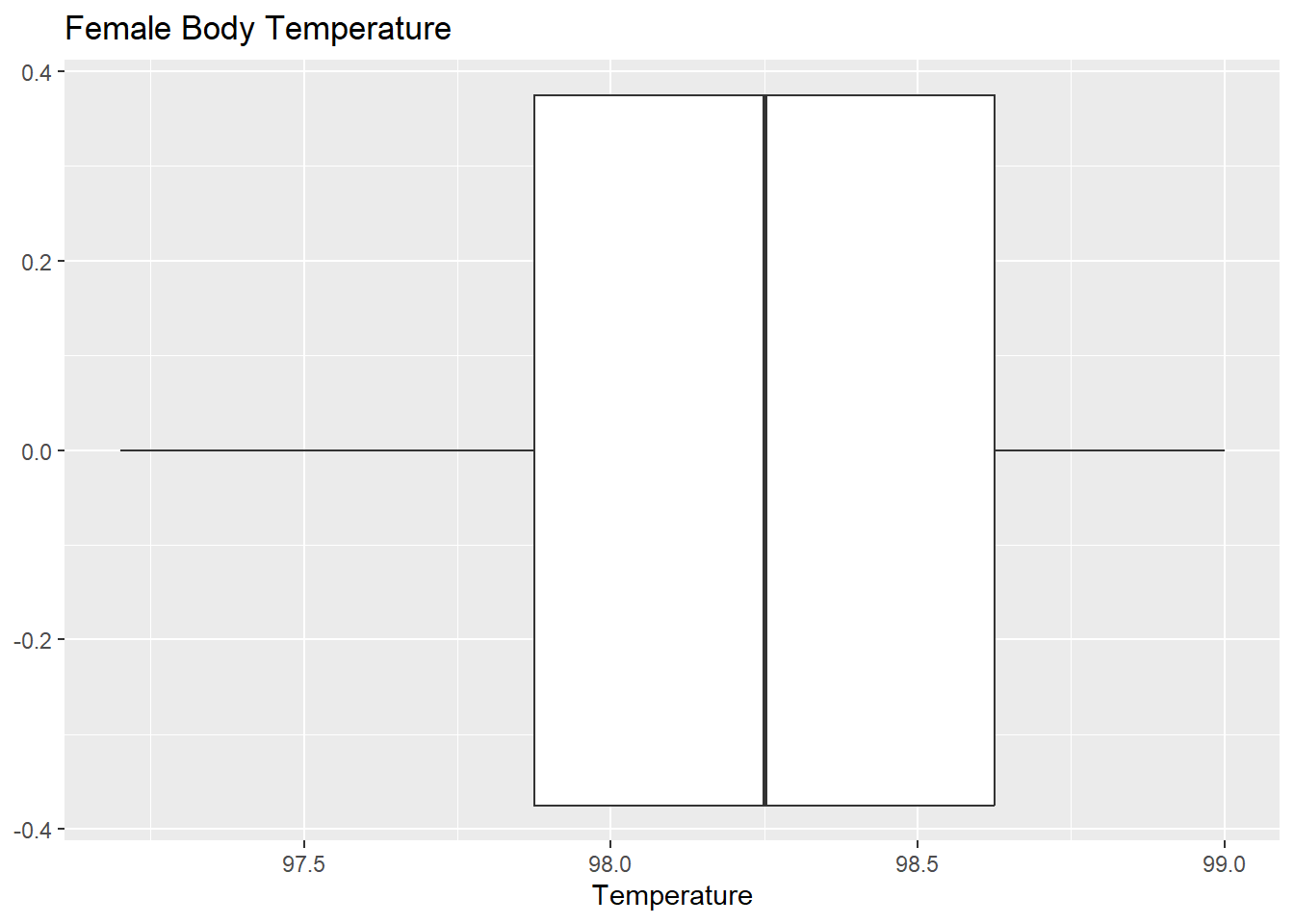
Code
df_prob1 %>%
  t.test(alternative = c("two.sided"),
         mu = 98.6,
         paired = FALSE,
         var.equal = FALSE)
    One Sample t-test

data:  .
t = -2.8824, df = 15, p-value = 0.01139
alternative hypothesis: true mean is not equal to 98.6
95 percent confidence interval:
 97.92596 98.49904
sample estimates:
mean of x
  98.2125
Code
#Computing the Test Statistic###########################################
df_prob2 %>%
  ggplot() +
  geom_density(
    aes(x = Before, fill = "Before"),
    alpha = 0.5) +
  geom_density(
    aes(x = After, fill = "After"),
    alpha = 0.5)+
  ggtitle("Delay Time Before vs After Alteration")+
  xlab("Delay Time")
Warning: Removed 1 rows containing non-finite values (`stat_density()`).
Removed 1 rows containing non-finite values (`stat_density()`).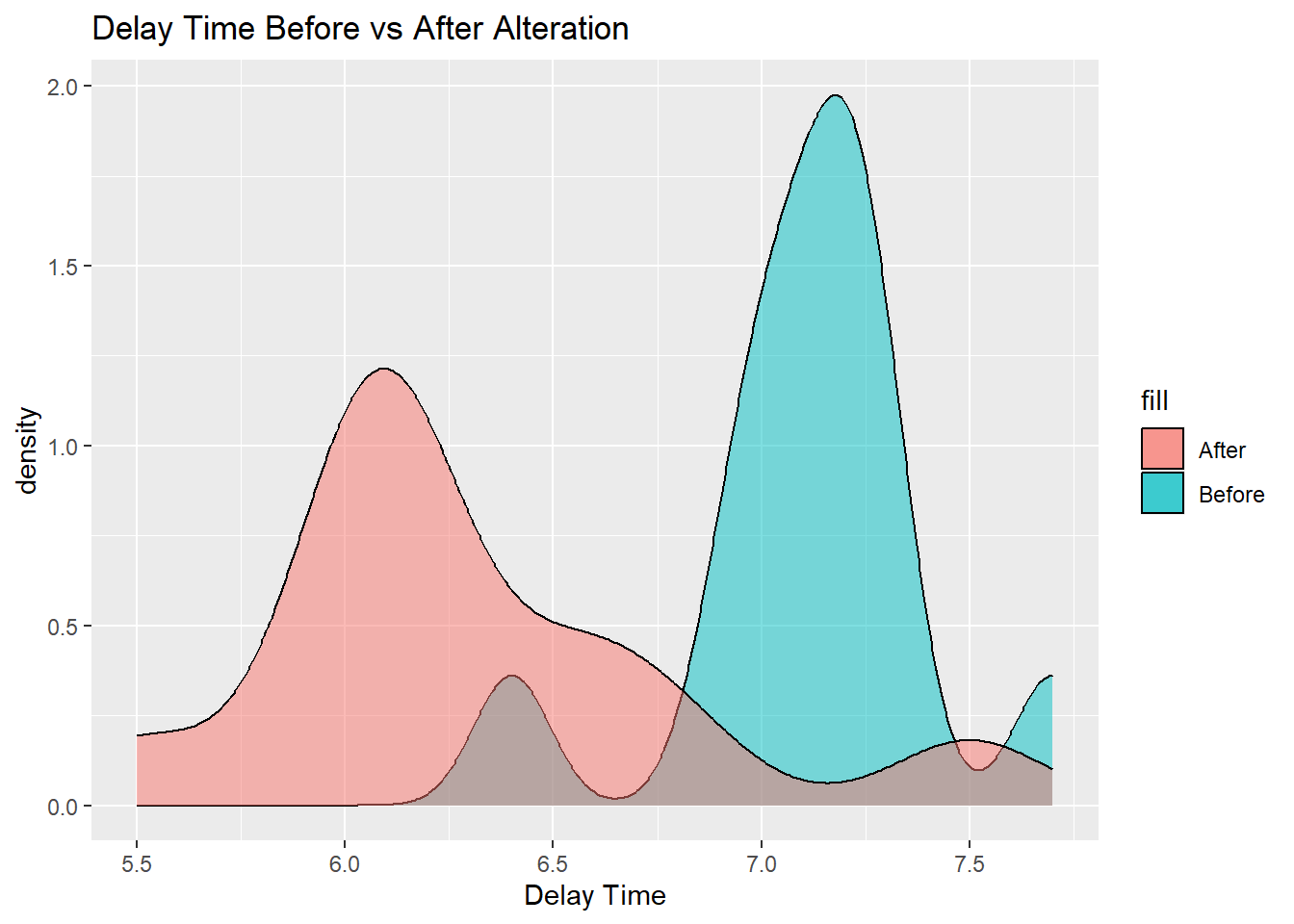
Code
df_prob2 %$%
  z.test(
    Before,
    After,
    alternative = c("less"),
    mu = 1,
    sigma.x = 0.3, sigma.y = 0.3,
    conf.level = 0.90)
    Two-sample z-Test

data:  Before and After
z = -1.4289, p-value = 0.07652
alternative hypothesis: true difference in means is less than 1
90 percent confidence interval:
        NA 0.9819574
sample estimates:
mean of x mean of y
 7.116667  6.291667
Code
#Computing the Test Statistic######################################################
df_prob3 %>%
  ggplot()+
  geom_boxplot(aes(BrandOne), fill = "lightslategray")+
  geom_boxplot(aes(BrandTwo), fill = "mediumaquamarine")+
  ggtitle("Distance by Golf Ball Brand")+
  xlab("Brand 1 vs Brand 2")
Warning: Removed 1 rows containing non-finite values (`stat_boxplot()`).Warning: Removed 1 rows containing non-finite values (`stat_boxplot()`).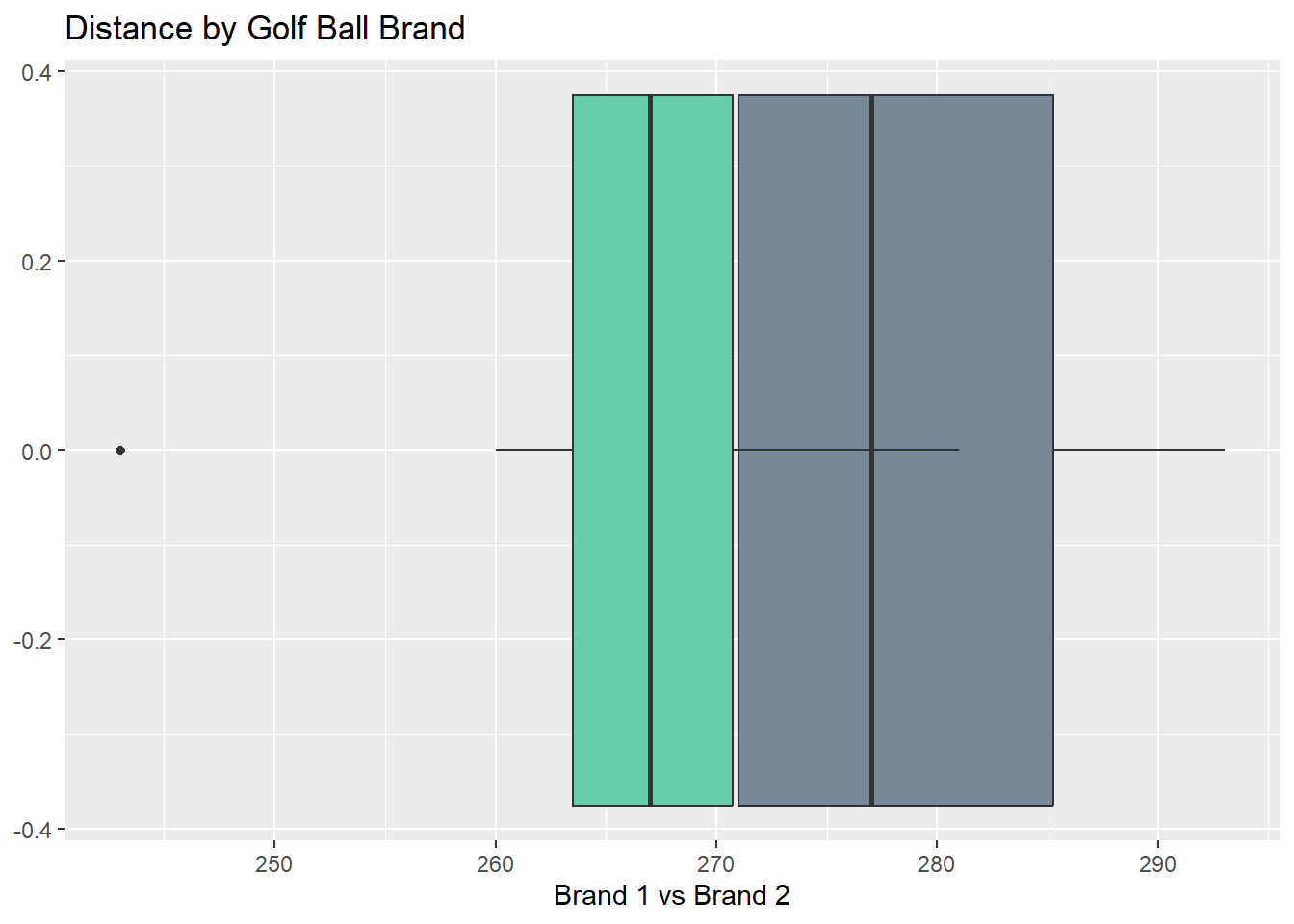
Code
df_prob3 %$%
  t.test(
    BrandOne,
    BrandTwo,
    alternative = c("two.sided"),
    var.equal=TRUE,
    mu = 0)
    Two Sample t-test

data:  BrandOne and BrandTwo
t = 2.6151, df = 18, p-value = 0.01753
alternative hypothesis: true difference in means is not equal to 0
95 percent confidence interval:
  2.260984 20.739016
sample estimates:
mean of x mean of y
    277.5     266.0
Code
#Computing the Test Statistic###########################################
df_prob4 %>%
  ggplot()+
  geom_density(
    aes(x = SolutionOne, fill = "SolutionOne"),
    alpha = 0.5)+
  geom_density(
    aes(x = SolutionTwo, fill = "SolutionTwo"),
    alpha = 0.5)+
  ggtitle("Etch Rates of Solutions")+
  xlab("Solution 1 vs Solution 2")
Warning: Removed 1 rows containing non-finite values (`stat_density()`).Warning: Removed 1 rows containing non-finite values (`stat_density()`).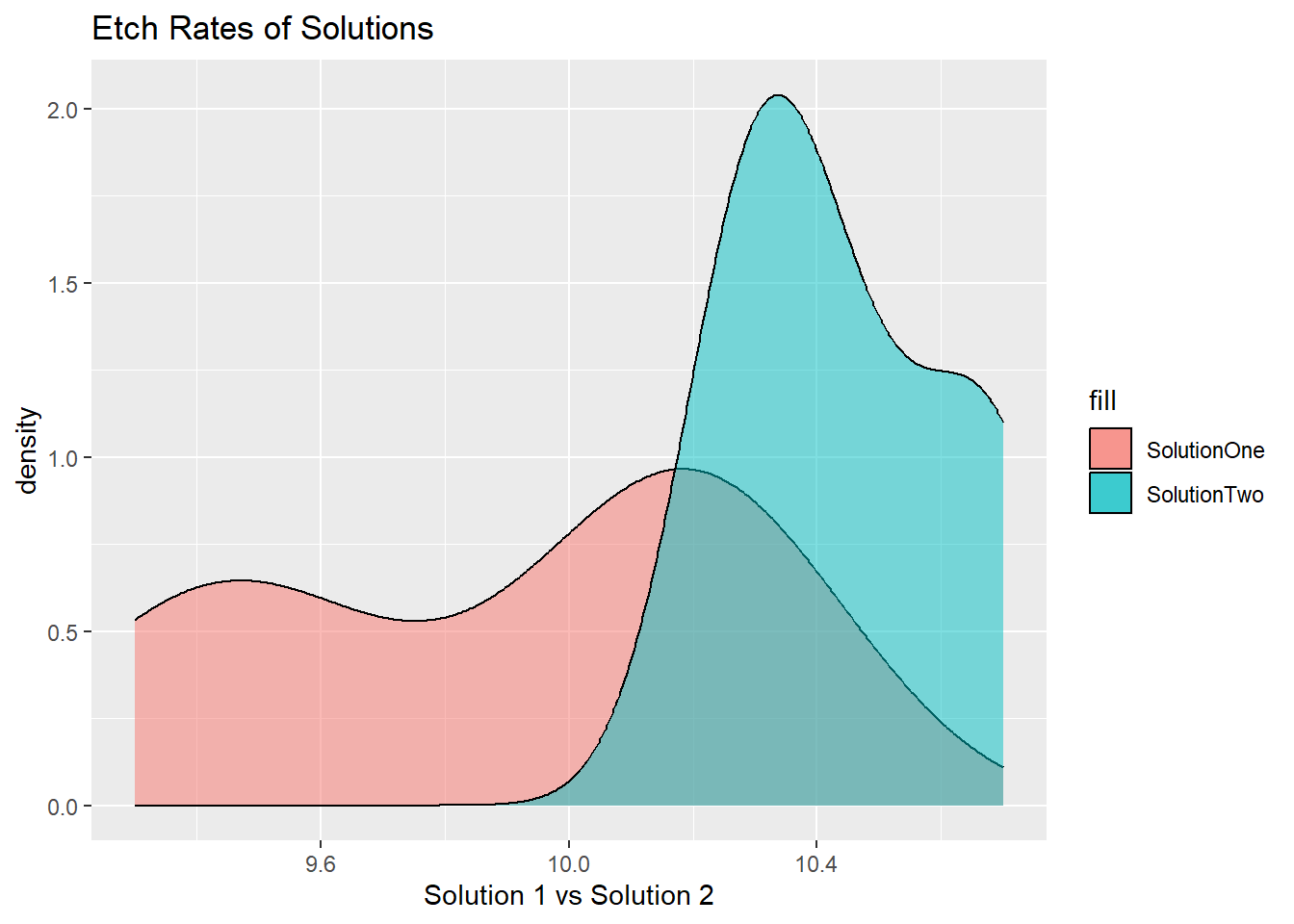
Code
df_prob4 %$%
  t.test(
    SolutionOne,
    SolutionTwo,
    alternative = c("two.sided"),
    var.equal=TRUE,
    mu = 0)
    Two Sample t-test

data:  SolutionOne and SolutionTwo
t = -4.0101, df = 18, p-value = 0.0008211
alternative hypothesis: true difference in means is not equal to 0
95 percent confidence interval:
 -0.838149 -0.261851
sample estimates:
mean of x mean of y
     9.89     10.44
Code
#Computing the Test Statistic###############################################
df_prob5 %>%
  ggplot()+
  geom_density(
    aes(x = FacilityOne, fill = "FacilityOne"),
    alpha = 0.5)+
  geom_density(
    aes(x = FacilityTwo, fill = "FacilityTwo"),
    alpha = 0.5)+
  ggtitle("Water Hardness by Facility")+
  xlab("Facility 1 vs Facility 2")
Warning: Removed 2 rows containing non-finite values (`stat_density()`).
Removed 1 rows containing non-finite values (`stat_density()`).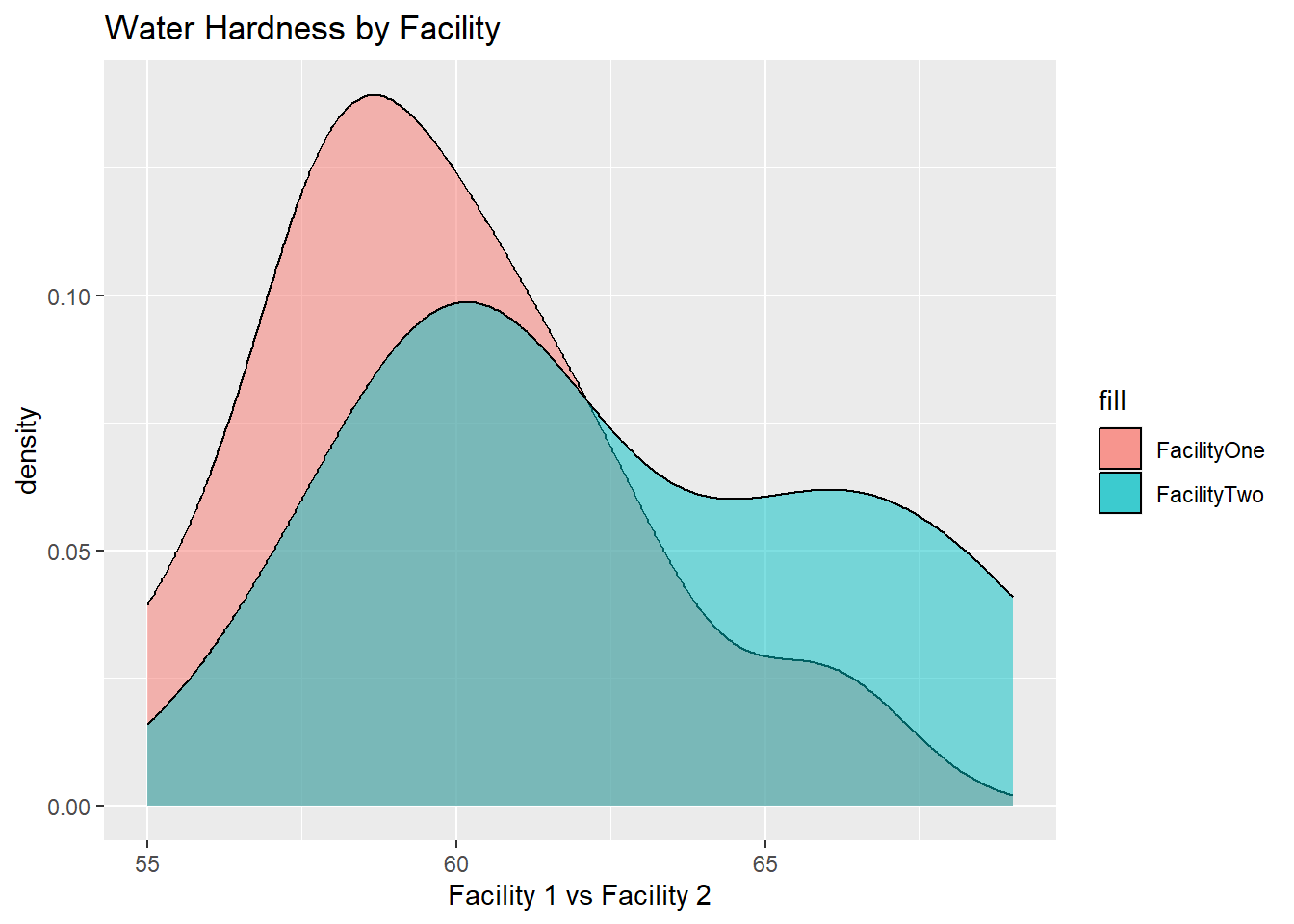
Code
df_prob5 %$%
  t.test(
    FacilityOne,
    FacilityTwo,
    alternative = c("two.sided"),
    var.equal=TRUE,
    mu = 0)
    Two Sample t-test

data:  FacilityOne and FacilityTwo
t = -2.0275, df = 23, p-value = 0.05436
alternative hypothesis: true difference in means is not equal to 0
95 percent confidence interval:
 -5.6335904  0.0566673
sample estimates:
mean of x mean of y
 59.75000  62.53846
Code
df_prob5 %$%
  t.test(
    FacilityOne,
    FacilityTwo,
    alternative = c("two.sided"),
    var.equal=FALSE,
    mu = 0)
    Welch Two Sample t-test

data:  FacilityOne and FacilityTwo
t = -2.0488, df = 22.358, p-value = 0.0524
alternative hypothesis: true difference in means is not equal to 0
95 percent confidence interval:
 -5.60847479  0.03155171
sample estimates:
mean of x mean of y
 59.75000  62.53846